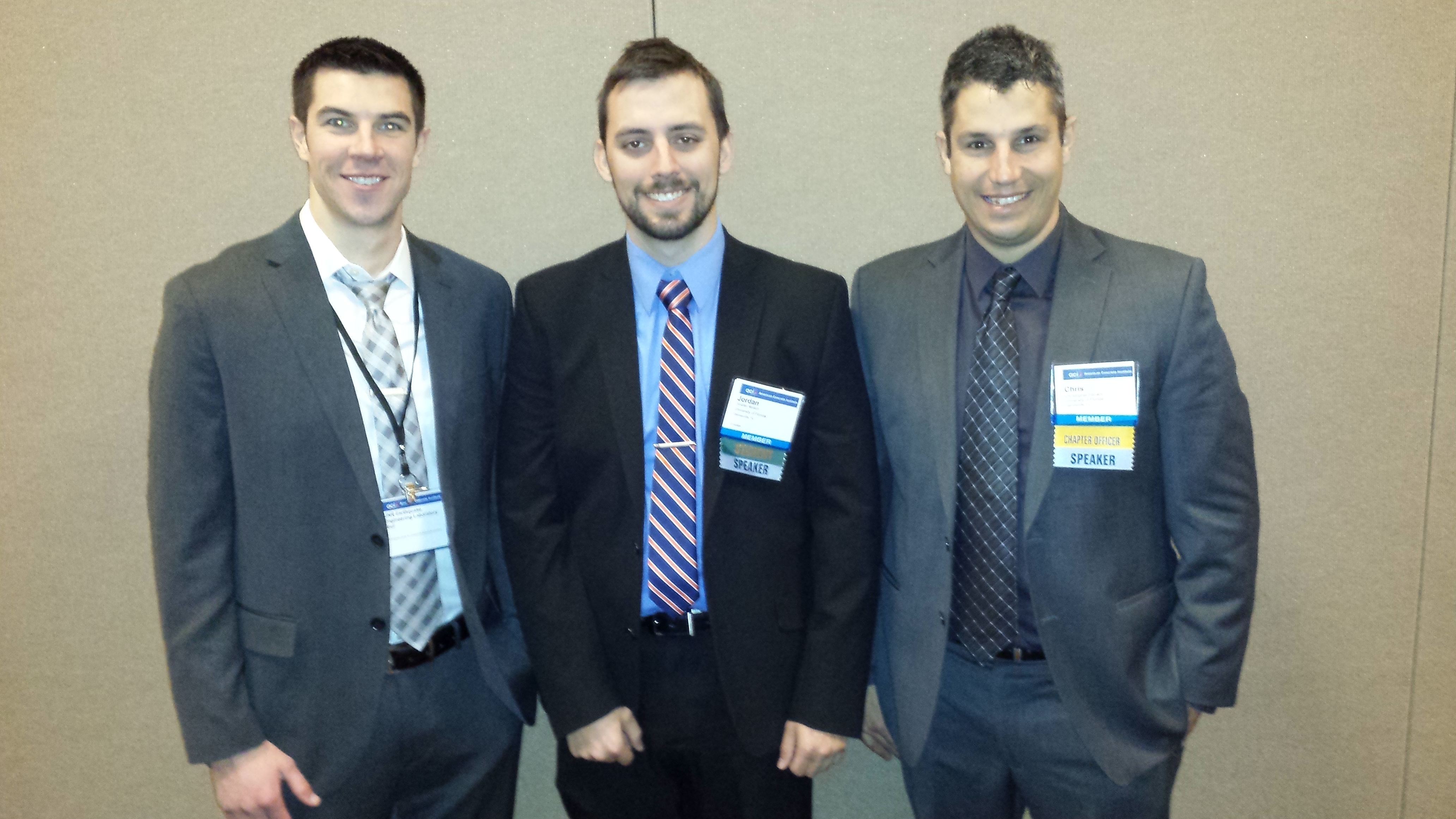
Presentation
of James Instruments Inc. award to Jordon Nelson. Pictured
(from left to right) Nate Rende WJE,
Nate Rende Lynde and Ferraro Engineering and Professor Chris Ferraro Ph. D.
Chicago, IL,
USA April 16th
,
2014,
James
Instruments Inc.
manufacturer of the world's most advanced Non Destructive Test
Equipment for construction materials presented The James Instruments Inc. - ACI Scholarship at the ACI spring
convention March 23rd,
2014. James Instruments Inc has exhibited at the ACI conventions since
1999. The company has found the convention an exciting place to meet
with customers, present the latest technology and learn about the
latest developments in the industry.
The ACI-James
Instruments Inc. student award was presented at the ACI spring
convention for research on NDT of concrete. James Instruments Inc
President, Michael Hoag had the honor to present the 2014 award to
Jordan Nelson for his research. His research
paper was chosen as the best of 10 entries by a panel of experienced
NDT professional.
The American
Concrete Institute (ACI) is a nonprofit technical and educational
society organized in 1904 and is one of the world's leading authorities
on concrete technology. ACI is a forum for the discussion of all
matters related to concrete and the development of solutions to
problems. ACI conducts this forum through conventions and meetings; the
ACI
Structural Journal
,
the
ACI
Materials Journal
,
Concrete
International
,
and technical publications; chapter activities; and technical committee
work. As its chartered objective states, its purpose is "to provide a
comradeship in finding the best ways to do concrete work of all kinds
and in spreading that knowledge."
James
Instruments specalises in Non-Destructive testing equipment for
concrete and other construction materials. Central to the
improvement of the
concrete infrastructure are tools that evaluate
the condition of existing construction. Destructive and non-destructive
testing (NDT) techniques are applied. Destructive tests can provide
direct information, but are relatively expensive, time-consuming and
cause damage to the structure. Destructive test results often cannot be
evaluated using statistical approaches because the number of locations
in the structure that can be tested without damage to the structure is
limited. On the other hand, NDT techniques are relatively inexpensive
to apply, and they can detect, localize, and characterize flaws and
damage in concrete structures without leaving any undesirable
discontinuities or causing damage to concrete members
.